Where Did the U.S. Military Tartans Come From?
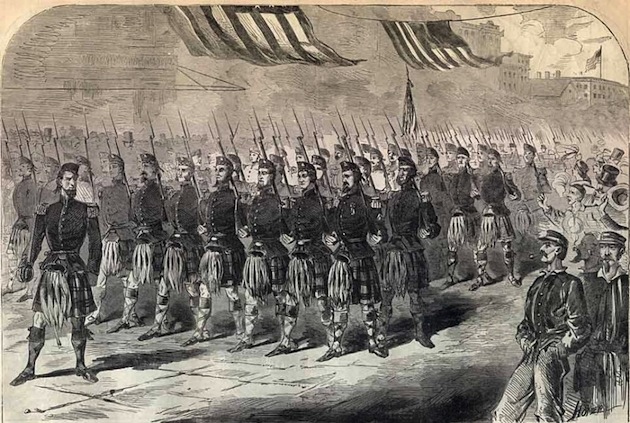
Military service and Scottish heritage have long shared a close connection. From Highland regiments to modern pipe bands, tartan has become a powerful symbol of pride, identity, and shared experience. Even in the early days, the power of the kilt and the pipes was acknowleded as a powerful vehicle for Esprit de corps. So much so that even British regiments which contained troops from across the Empire would readily adopt these trappings. (just look at the Indian Army for a glimpse of this heritage)
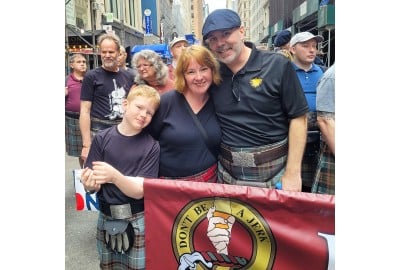
But in America it has veloved into someting more personal. Some units of our various military branchs have their one bagpipe bands, yes. However only one has an official tartan. For the rest, tartan and the wearing of the kilt as a way to show service, pride and camaraderie has been a matter of personal initiative.
Today, every branch of the U.S. military has an associated tartan. A variety of quests to fill a gap and give service members, veterans, and their families a bold way to celebrate and recognize one another.
Unlike clan tartans that can date back centuries, U.S. military tartans are a much more modern tradition. They are also pretty unique. For instance, British military units typcally have a clan tartan associated with them or wear "the government sett" (Blackwatch), not a design created just for them.
Do You Have to Have Scottish Heritage to Wear a Military Tartan?
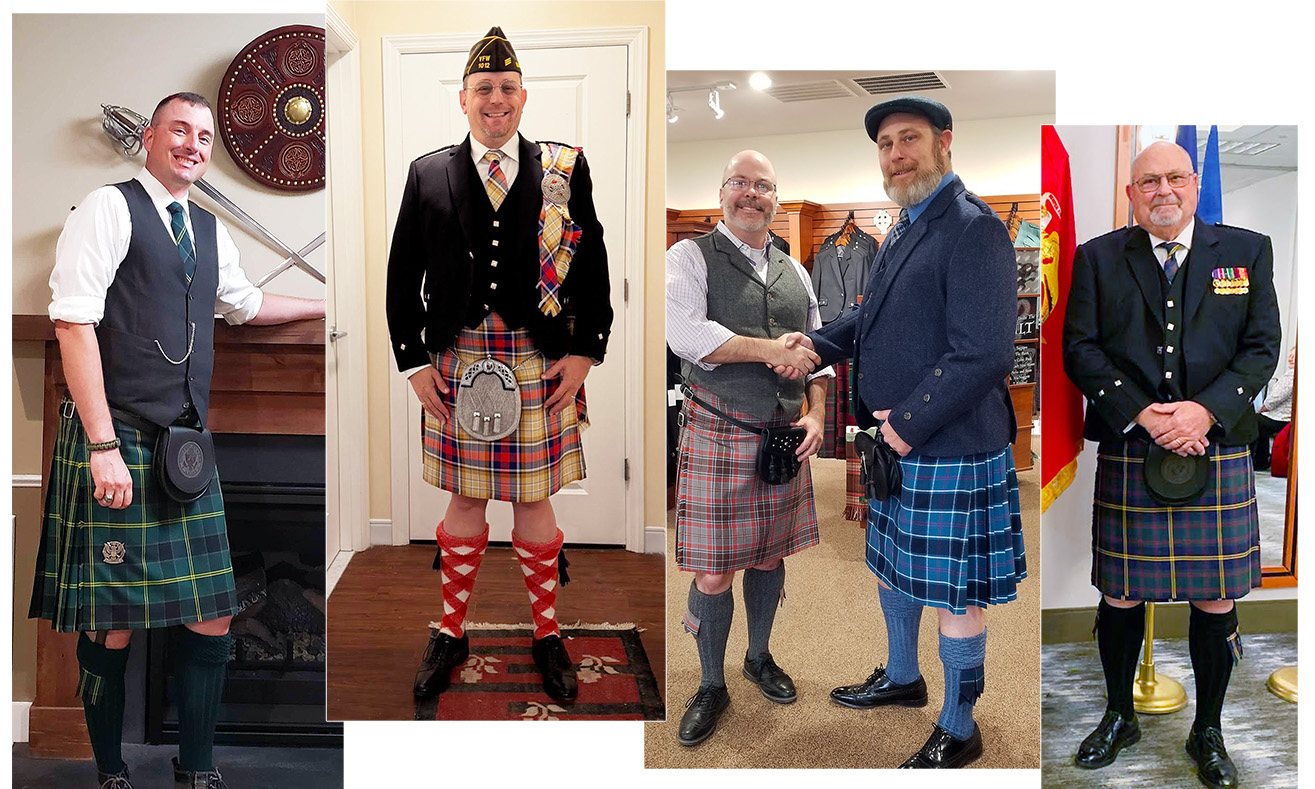
Let's just get this out of the way first. All of the U.S. military and veterans' organization tartans are Universal. You do NOT have to have Celtic heritage (Scottish, Irish or anything else) to wear the kilt or these tartans. Frankly anyone can wear the kilt. Period. If you are not a member of a specific branch, we advise against wearing their tartan unless you have a very close connection such as a family member. We are not talking stolen valor here, but we are talking "this is how you avoid awkward conversions."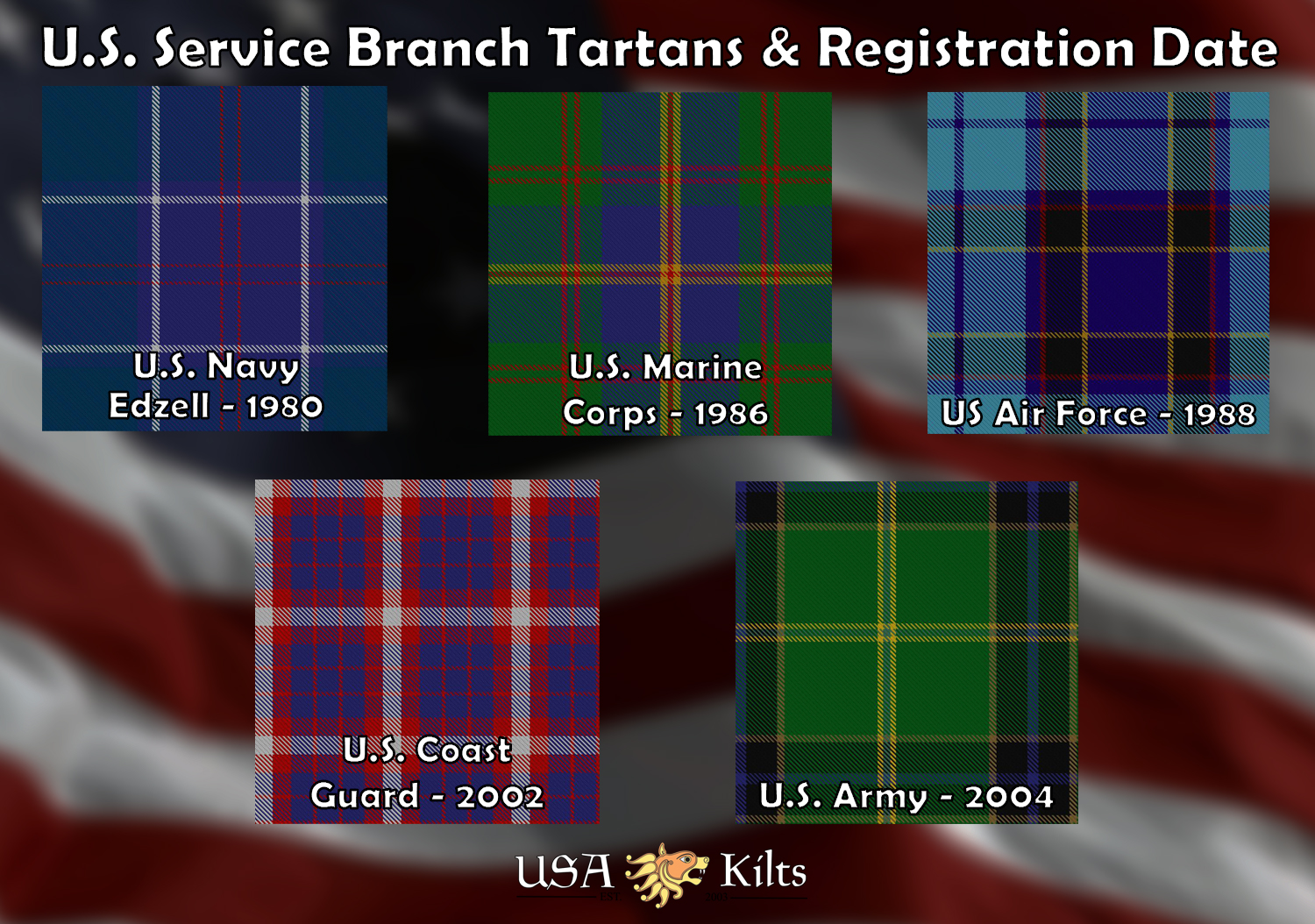
Are The Military Branch Tartans Official Uniform?
No, the one exception being the Coast Guard and that is just for their band.
One of the biggest misconceptions about military tartans is that they were officially commissioned by the U.S. government or are part of military uniforms. In reality, most branch or unit tartans were adopted into popular use because veterans and service members wanted a tartan. Rather than being designed by the military itself, these tartans were grassroots efforts that gained popularity within the military community.
They include:
Today, each of these tartans is woven regularly ensuring they're available for kilts and accessories for veterans and supporters alike. We are often asked if it is proper to wear the kilt with a military tunic, jacket or shirt, or with service medals.
Generally speaking if the function is a civilian one, you're fine. We will go into more detail on this in another article, but for now assume you are not dishonoring the uniform if you design a Highland Dress outfit that incorporates your branch tartan and maybe borrows one or two uniform elements. For instance, you can always display your service decorations on a Highland jacket such as a Prince Charlie coatee. In that case, just make sure you are correctly displaying the right ones (full vs minis) and in the proscribed manner depending on time of day and formality (consult your regulations). For "casual wear" like at a festival, you may wish to take inspiration from some pipe band uniforms.
The colors used in each service tartan often draw inspiration from uniforms, insignia, or history.
The U.S. Navy tartan actually has it origins in Scotland through the U.S. Navy installation at RAF Edzell in Angus. Beginning in 1960, this Royal Air Force station was leased to the U.S. Navy and operated primarily as a Navy Security Group (signals intelligence) facility until its closure in 1997. The tartan was designed by Arthur Mackie of Strathmore Woollens to commemorate the close relationship between U.S. Navy personnel stationed at RAF Edzell and the surrounding Scottish community. It was first unveiled in 1985, commemorating the 25th anniversary of the U.S. Navy's presence at Edzell.
The colors were chosen deliberately:
- Dark blue for the U.S. Navy
- Light blue for the U.S. Air Force (since Edzell was an RAF station)
- Red for the U.S. Marine Corps and U.S. Army
- White for the waves of the ocean
The U.S. Army tartan was the last of the main branch setts created. In 2004, it was designed in conjunction by Raymond Jones and Alexis Malcolm, though the Scottish Register of Tartans simply lists the designer as Strathmore Woollen Company Ltd.
The color choices were uniform-based:
- Black: the army beret
- Khaki: summer uniform
- Light green: a nod to the original sniper / summer uniform
- Dark blue: original dress uniform
- Olive: combat uniform
- Gold: cavalry
The U.S. Air Force tartan was designed in 1988 by Arthur Mackie of Strathmore Woollen Company as an unrelated fashion tartan called "Lady Jane of St Cyrus." After members of the Band of the Air Force Reserve at Dobbins Air Reserve Base adopted the design in the early 1990s, it became known as the U.S. Air Force Reserve Pipe Band tartan and gradually came to represent Air Force service more broadly. Like other military branch tartans, it has never received official Department of the Air Force recognition. However, decades of use by Air Force musicians, veterans, and families has established it as a de-facto symbol of pride.
While there was no thought to color meaning in the design originally, it is popular to imagine the elements as:
- Light blue for the sky
- Dark blue for the Air Force dress uniform
- White for clouds
- Gray for aircraft and technology
The U.S. Coast Guard tartan was born from a simple idea at a Scottish festival in 1997, when Chief Warrant Officer Mike Pendleton remarked that the Coast Guard deserved a tartan of its own. His wife, JoAnne Pendleton, transformed that idea into a service-wide project, securing the support of Coast Guard leaders and designing a tartan based on the Hamilton tartan to honor Alexander Hamilton, founder of the Revenue Cutter Service. Officially approved by Commandant Admiral James Loy on May 1, 2002, the tartan incorporates Coast Guard Blue for the seas and skies, red for the courage and sacrifice of Coast Guard families, and a white ten-thread stripe representing the ten original Revenue Cutters. Today it remains the only U.S. military service tartan to receive formal endorsement from its service headquarters.
The Coast Guard tartan colors have intentional symbolic meaning:
- Coast Guard Blue replaces the original Hamilton blue, representing the seas and skies where Coast Guard cutters and aircraft serve.
- Red symbolizes the courage and sacrifice of Coast Guard members and their families in both war and peace.
- The distinctive white ten-thread overstripe represents the ten original Revenue Cutters authorized by Alexander Hamilton in 1790, the beginning of the service.
Is There a Universal Tartan for Veterans?
The evolution of military tartans didn't stop with the service branches. Numerous more specialized tartans have been designed for units, awards, military bases, theatres of operations, etc. Most are passion projects and not too many are woven regularly. For example the 'Broken Arrow' tartan and the 'Sea Bees' tartan.
As veterans' organizations continued embracing Scottish tradition, many saw the opportunity to create tartans representing the lifelong bonds formed through military service. Organizations like the Scottish American Military Society helped foster interest in preserving both military history and Scottish heritage culture, while veterans themselves continued creating new tartans to honor shared experiences.
It was this spirit that eventually led to the creation of the Veterans of Foreign Wars tartan.
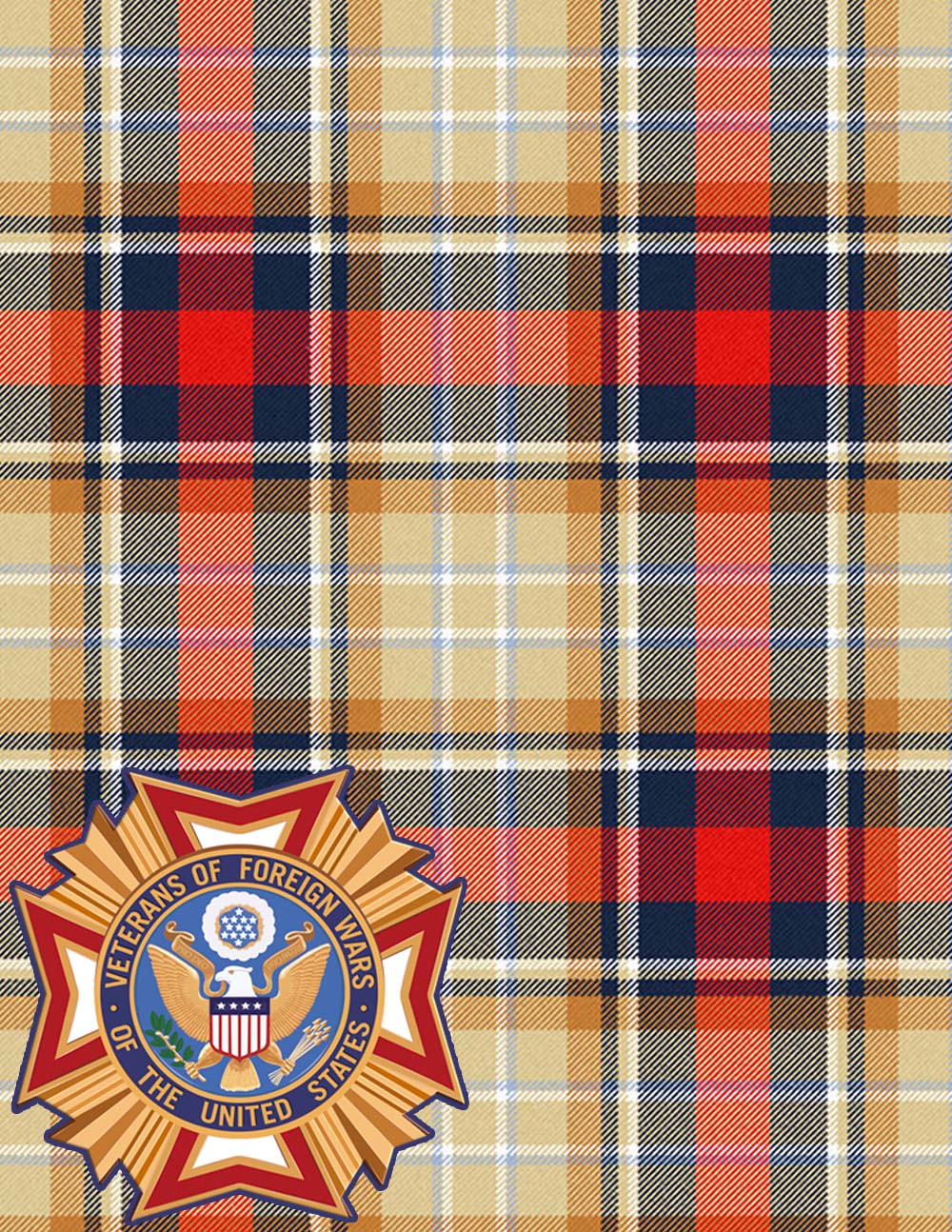
The VFW Tartan: Weaving Service, Sacrifice, and Brotherhood
In 2025, the Veterans of Foreign Wars of the United States formally introduced the official VFW tartan, a new symbol designed to reflect the organization's enduring values, history, and shared experience of overseas service. Created by Joshua Cannon, VFW Life Member #6224526, the tartan is authorized for wear by VFW members in good standing and their families.
Like the military branch tartans before it, the VFW tartan grew from the passion of one veteran who believed his organization deserved its own enduring symbol.
More Than Just Pretty Patterns
Whether it's the Army, Navy, Marine Corps, Air Force, Coast Guard, or the Veterans of Foreign Wars, military tartans all tell a similar story. They weren't created because someone ordered them into existence. They were created because veterans and service members wanted a lasting symbol of their shared experiences, sacrifices, and pride.
For military families with Scottish ancestry, a military tartan offers a doubly meaningful way to honor both service and heritage. These tartans continue to remind us that while uniforms may eventually be hung in the closet, the bonds of service last a lifetime.