The Eighteenth Century: Scotland Opens to the World
The eighteenth century marked a turning point in Scotland’s place on the world stage. And this included more and more visitors.
While travel had previously been driven by religion, trade, education, or politics, a new motivation emerged… exploration for pleasure and personal enrichment.
Across Europe, members of the upper classes were traveling to broaden their cultural horizons. This growing appreciation for landscapes, history, architecture, and local traditions gradually transformed Scotland from a distant northern kingdom into a destination worthy of exploration.
Several important developments occurred simultaneously. Roads improved, political stability increased after decades of unrest, literature sparked widespread fascination with the Highlands, and Enlightenment thinkers elevated Scotland's intellectual reputation.
Together, these forces laid the foundation for Scotland's modern tourism industry.
The Grand Tour Expands North
For much of the seventeenth and eighteenth centuries, wealthy young Europeans, particularly those from Britain, undertook what became known as the Grand Tour.
Traditionally, these journeys focused on France, Italy, Switzerland, and classical sites associated with Ancient Rome and Greece. Visiting Paris, Florence, Venice, and Rome was considered an essential part of a gentleman's education well into the Victorian age.
Scotland initially sat outside this established itinerary. Many southern travelers viewed it as remote, economically underdeveloped, and politically unstable. In short, a dreary and dangerous backwater.
In 1707 the Acts of Union joined the Scottish and English Parliaments, creating the Kingdom of Great Britain. Initially this was an uneven arrangement. Scotland needed economic help badly after the crushing ruin of the failed Darian Scheme in Panama. England needed a stable, and Protestant, Scotland for security.
The story of the Jacobites flows from this early, pivotal event. However, despite the chaos of the Uprisings and their aftermath, the fact that England and Scotland were now closer united than ever before was a hard fact.
In the latter half of the century as things calmed down, more and more people became fascinated with Scotland for a variety of reasons. Explorers who might once have stopped in York or Newcastle increasingly continued north to Edinburgh and beyond.
Scotland never replaced Italy as the centerpiece of the Grand Tour, but she did gradually become an attractive extension for travelers seeking dramatic scenery, intellectual culture, and historical landmarks closer to home.
The Scottish Enlightenment and the Athens of the North
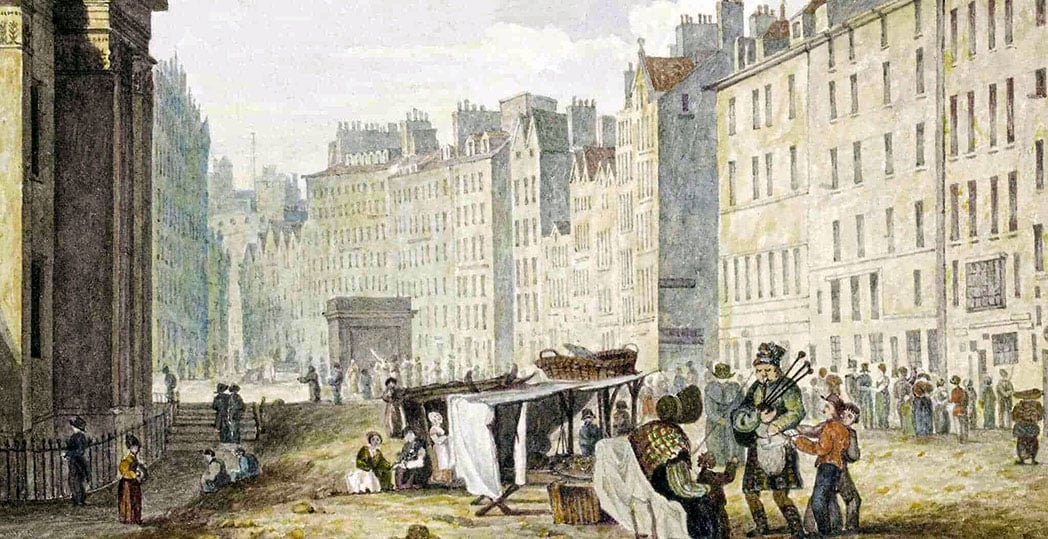
By the early eighteenth century, Edinburgh had established itself as one of northern Europe's most influential cities. Narrow medieval streets bustled with merchants, lawyers, clergy, students, and craftsmen. The capital's towering stone tenements impressed visitors as much as the castle and public edifices.
It was a place of striking contrast. In A Tour Thro' the Whole Island of Great Britain (1727), English writer Daniel Defoe praised Edinburgh's "buildings" as "surprizing both for strength, for beauty, and for height," yet also observed that "in no city in the world so many people live in so little room as at Edinburgh."
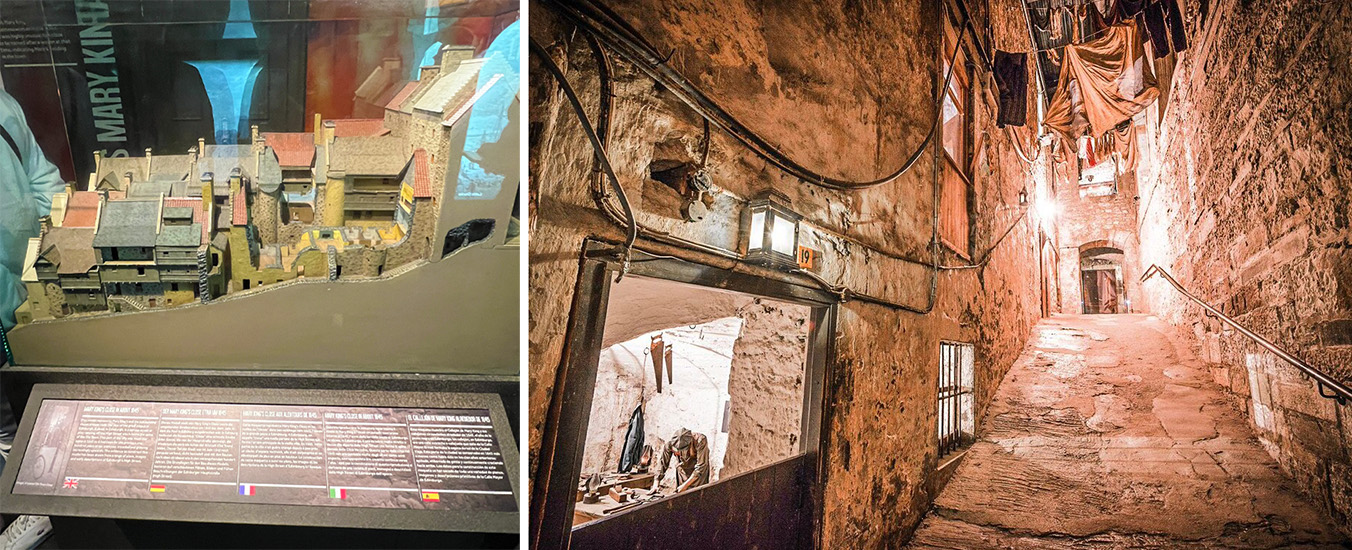
EXPLORE IT TODAY:
For a peek at what urban life was like for the average person in historic Edinburgh, visit Mary King’s Close.
But the culture and identity of the city was about to skyrocket.
As the chaos of the Jacobite period subsided, the ‘Scottish Enlightenment’ transformed Edinburgh into one of Europe's leading centers of learning.
It was a buzzing hive of philosophy, science, and literature. Scholars, philosophers, physicians, engineers, and economists developed groundbreaking theories that influenced governments and universities around the world. Intellectuals descended to hear lectures, attend debates, and meet renowned thinkers.
The most influential figures have since been recognized as giants:
-
Adam Smith, whose writings reshaped economic thought.
-
David Hume, one of history's most celebrated philosophers.
-
James Hutton, regarded as the father of modern geology.
-
Joseph Black, whose discoveries advanced chemistry.
-
William Robertson, a respected historian and university leader.
And Edinburgh herself became known as the "Athens of the North."
This epithet reflects the mix of intellectual brilliance and striking visual similarities to ancient Greece that was noticed, and then intentionally expanded and exploited to get even more attention.
Just as Athens had the Acropolis, Edinburgh featured dramatic volcanic crags and hills overlooking the sea, such as Castle Rock and Calton Hill.
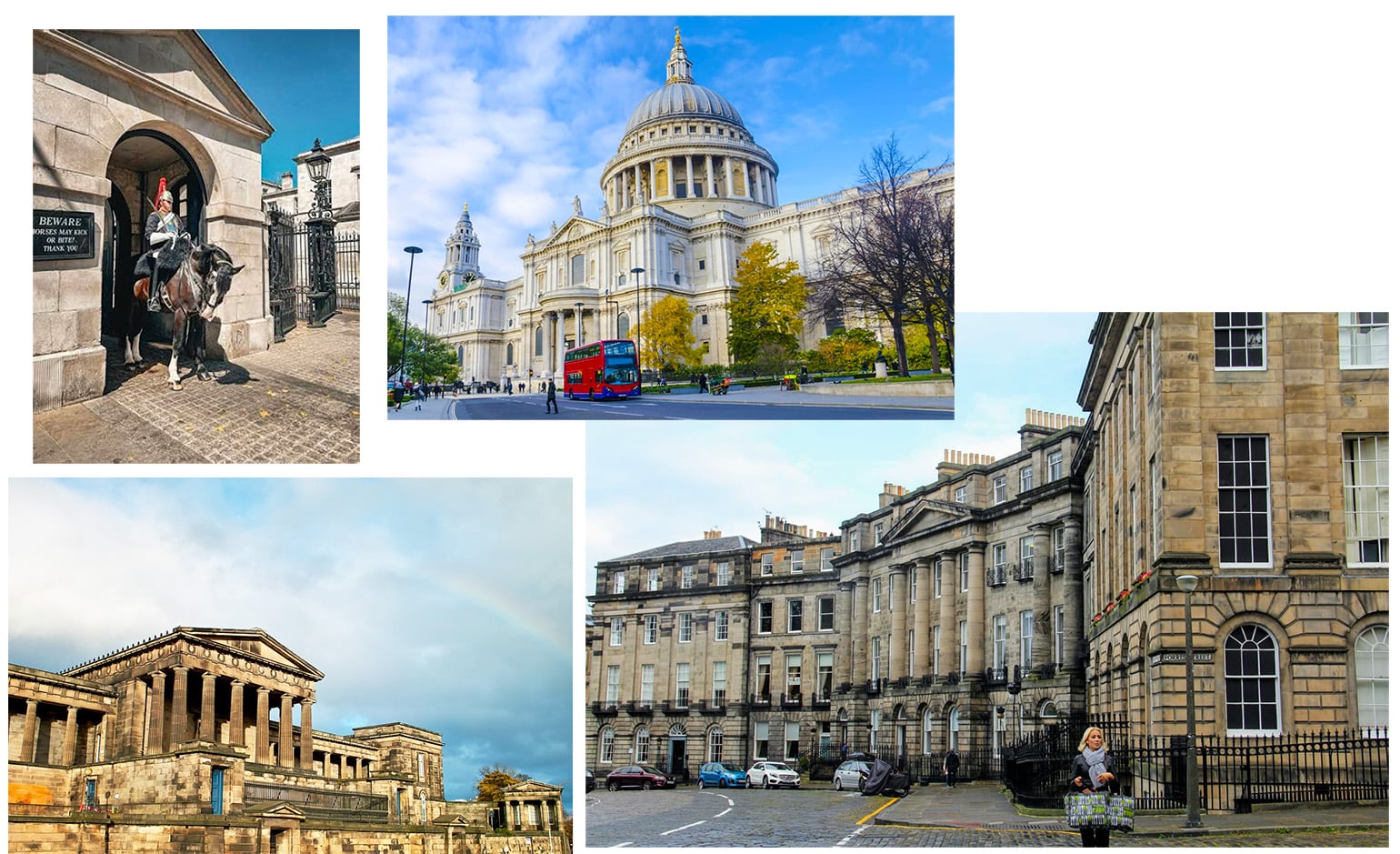
The Georgian Style, a form of neoclassical architecture, exploded across the city… most strikingly in New Town. Structures like the National Monument on Calton Hill were intentionally designed to mirror the Parthenon in Athens.
In 1822, this public image was cemented when Scottish artist Hugh William Williams produced an explicit comparison by exhibiting his paintings of Athens alongside views of Edinburgh.
Travelers increasingly included libraries, universities, museums, and salons alongside castles and churches on their itineraries.
(If you personally prefer those ancient ruins and craggy mountains, don’t worry your turn is coming up next.)
EXPLORE IT TODAY:
When you get tired of the tourist-crammed streets of Edinburgh and to need some fresh air, make sure you do the hike up Arthur’s Seat. This ancient extinct volcano offers unparalleled views of the city’s architecture. Yes, you will still be around some people, but the openness makes that less intense. It’s refreshing and the views will absolutely spark your imagination!
Samuel Johnson and James Boswell Explore Scotland
"This is the most extraordinary place that I have ever beheld."
— Samuel Johnson on Staffa, A Journey to the Western Islands of Scotland (1775)
Beyond Edinburgh’s glow of rational civilization, the wilderness of Scotland called to people just as it does today.
This included two literary heavyweights of the eighteenth century, Samuel Johnson and James Boswell, who in 1773 set out together to uncover the "real" Scotland.
Johnson, already one of Britain's leading writers, initially approached old Alba with skepticism. Boswell, on the other hand, was proudly Scottish and persuaded his friend to undertake an ambitious trek through the Highlands and the Hebrides.
Their travels covered hundreds of miles by horse, carriage, and boat. They visited castles, villages, islands, churches, and estates all the while engaging with local residents to learn about language, customs, agriculture, religion, and daily life. Though lacking modern scientific rigor, this was a serious ethnographic and anthropological endeavor, before those disciplines existed. Personally, I wish they would make a movie about the trip... maybe a buddy picture?
Following the exporers' return, both men published detailed accounts.
Johnson's A Journey to the Western Islands of Scotland and Boswell's Journal of a Tour to the Hebrides became widely read throughout Britain.
Although Johnson occasionally criticized aspects of Highland life, he also praised the hospitality, resilience, and striking scenery he encountered. For example, he described Fingal's Cave, Staffa thus…
"We saw the cave by a very commodious entrance, and went into it without difficulty. Its height is such as admits a boat to be rowed through it, and its extent is sufficient to afford a very spacious habitation. The mind is filled with pleasing astonishment, at the sight of this magnificent work of nature."
The expedition also served to humanize the rural people of Scotland…
- Johnson: "We were everywhere received with kindness; and everywhere found an elegant sufficiency."
- Boswell: "We were entertained with that frank and liberal hospitality for which the Highlanders have long been celebrated."
Today we check Reddit or watch a few youtube videos for ideas. Two hundred years ago, you read Johnson and Boswell, arguably the very first travel guides to Scotland.
The Romantics Lose Themselves in Wild Scotland
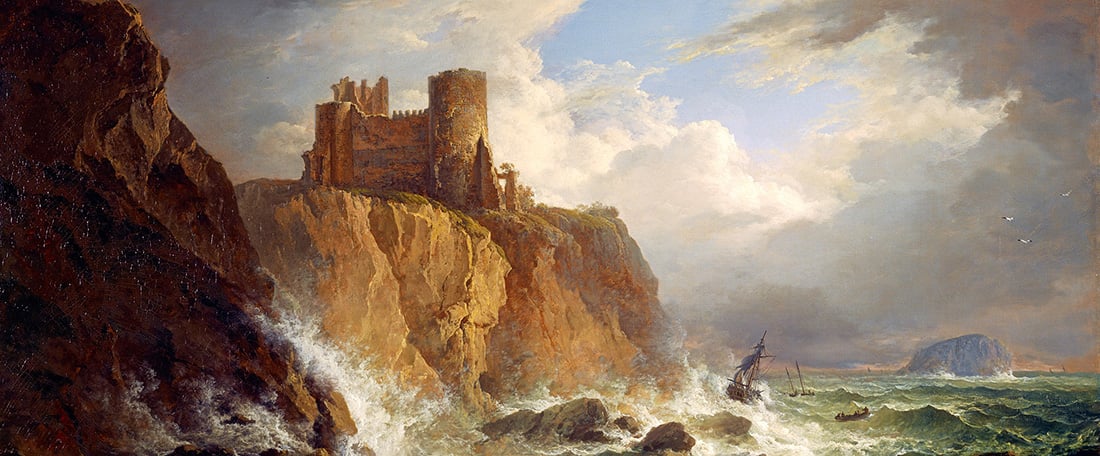
Before the eighteenth century, mountains often inspired fear rather than admiration. Steep cliffs, stormy coastlines, dense forests, and rugged glens were little more than dangerous obstacles.
However now that early writings such as the accounts by Johnson and Boswell had exposed the British public to the idea of the Highlands, a new perception began to inspire wander lust. Here was a place for romantics.
But I'm not referring here to people who like heart-shaped bathtubs. No, these were the original Romantics... passionate "back to nature" types who followed in the footsteps of the French philosopher Rousseau.
The Romantic movement (generally thought of as 1780–1830) was an artistic and literary movement that emerged as a reaction to the Enlightenment and the early Industrial Revolution. Rather than celebrating reason and scientific progress, Romantic thinkers emphasized emotion, imagination, wild landscapes, and the mysteries of history and folklore. Writers such as William Wordsworth, Lord Byron, Percy Shelley and artists like J.M.W. Turner and Beethoven, led a crusade for living with intensity and following one's instincts, desires and spiritual callings.
And yes our beloved Sir Walter Scott was among them. His novels and poems are very much the result of a Romantic viewpoint, as was his passion for a new sense of national pride for Scotland.
Where Johnson and Boswell were quasi-scientific geographers and ethnographers, the Romantics were seekers. Scotland possessed exactly the kinds of landscapes for which they yearned. The Highlands took on the guise of an ancient, semi-mythical land of freedom and natural grandeur… a place where strong people lived purer, more dramatic, more meaningful lives unspoiled by the evils of civilization and capitalism.
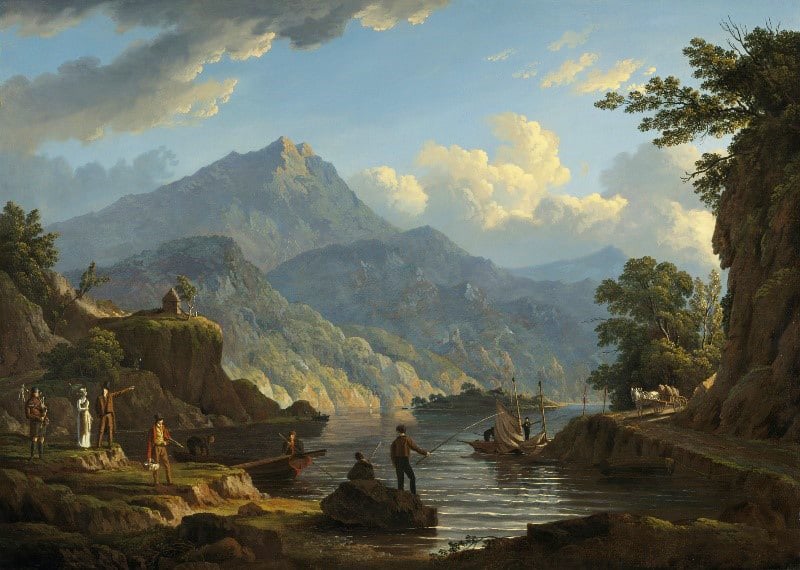
The awe-inspiring mountain vistas, rushing waterfalls, mist-covered lochs, and of course the haunting ruins, became the new focus of pilgrimage. And naturally the artistic outpouring that followed inspired even more people to come to Alba. The quest for a heritage connection would, in time, also be ignited by this very movement.
EXPLORE IT TODAY:
Okay, not a destination suggestion this time, but rather a list of works by the Scottish romantic masters which you may want to consider reading before your trip:
Waverley (1814): THE landmark novel that more than anything else romanticized Jacobite rebellions and Highland culture.
The Lady of the Lake (1810): This is Scott's medieval fantasy narrative poem. It launched tourism to the Trossachs.
James Macpherson: Fragments of Ancient Poetry / Ossian (1760) ... The frankly amazing though fabricated mythic Gaelic epics that hypnotized all of Europe.
John Keats: Poems written in the Highlands (1818) ... Energetic, rugged verse inspired by Keats' experiences in Staffa, Iona, and Ben Nevis.
If nothing else I really recommend you read Waverly and some Burns poetry. In fact, I always travel with a small copy of Poems. Something to relax with in bed after a busy day of exploring.
And speaking of Burns....
Robert Burns Becomes an Icon ... and a Destination
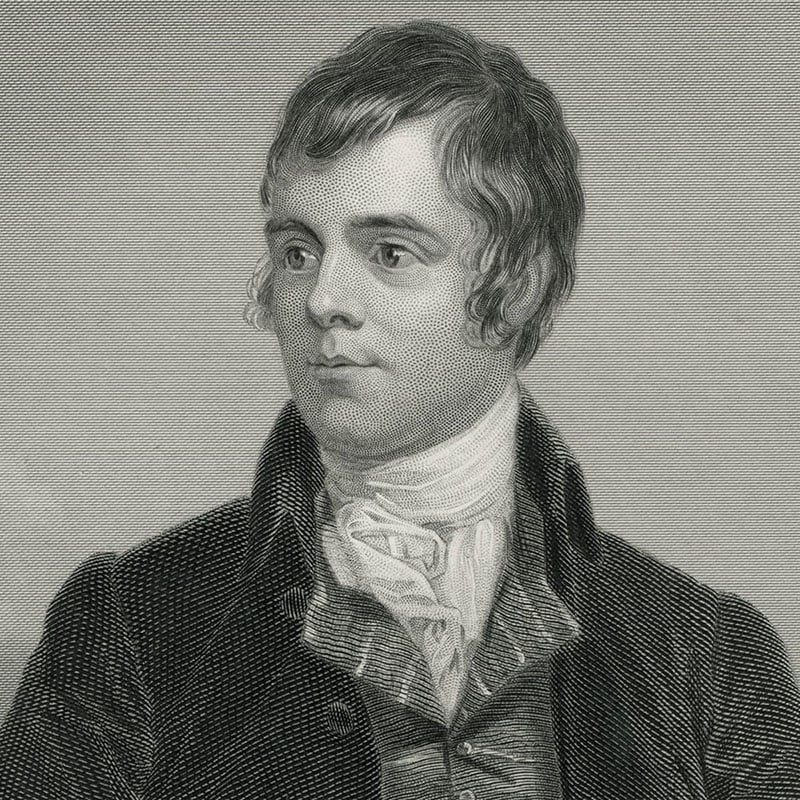
In Robert Burns, we find a wonderful synthesis of so many things we think of as "Scottish." And peope wo knew him personally, and read the very first editions of his works thought so too.
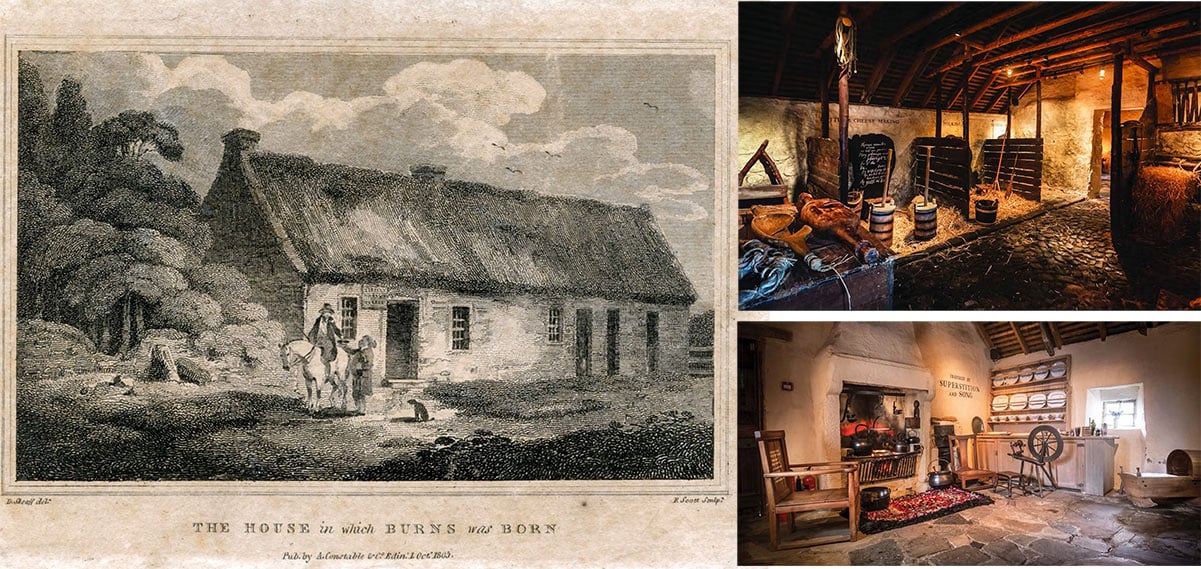
Born in 1759, Burns was destined to be regarded as Scotland's national poet. His poems and songs celebrated rural life, love, humor, social justice, and Scottish identity like nothing had before (or since).
The first Burns Supper was held on July 21, 1801, marking the fifth anniversary of the young poet's death. Nine close friends gathered at the Burns cottage in Alloway to honor his memory with food, poetry, and a tribute speech. Later the event was moved to his birthday, January 25.
I sometimes wonder what Rabbie Burns would think of the heaped on celebrity he holds today. I think he'd be pleased actually, though I also feel he would scoff at some of the pageantry we load into Burns Night celebrations. I think he'd prefer the rough and ready versions held in homes and pubs to the fancy dress-up affairs.
If you want to host your own Burns Supper, we have an article about how to do it.
However very early on it was not merely this observance that gained popularity. Burns grounded his verse in real Scottish places weaving in local landmarks he knew well. Thus in addition to the cottage, admirers would (and do) visit sites like the Alloway Kirk and the Brig o' Doon (both in Tam o' Shanter), the River Afton (Sweet Afton), and the battlefield of Bannockburn (Scots Wha).
Pilgrimages to honor the "Bard of Ayrshire" stand as one of the great examples of true literary tourism. A tradition that continues today with authors ranging from Sir Walter Scott to J.K. Rowling.
EXPLORE IT TODAY:
Hundreds of thousands of visitors every year visit the humble thatched cottage that was the childhood home and birthplace of Robert Burns in Alloway. The site is managed by the National Trust for Scotland and includes a comprehensive museum.
The Seeds of Heritage Tourism:
The Jacobites, Romance and the Crafting of Identity
Heritage draws many of us to Scotland. Yet it is rarely a simple genealogical chart that sucks us into our love of the old country. That comes from stories... some real, some mythic. Regardless of facts, each one has the power to fire our imaginations because it seems so easy to place ourselves in the shoes of the men and women who lived those stories.
And naturally one of the greatest stories of them all is the Jacobite Uprising of 1745 - 46 ... THE Uprising ... the '45.
The defeat at Culloden in 1746 marked the end of the Jacobite cause. In the aftermath, the British government imposed measures aimed at destroying the clan system and this included attempts to curtail expressions of Highland culture.
Highland attire faced severe restrictions under the Dress Act of 1746. Many clan chiefs lost authority, and military occupation expanded throughout the Highlands. Culloden was the deathknell of the clan system with Jacobite chiefs losing everything and loyalist chiefs having their authority all but erased. Economically and politically the Highlands were under threat as never before and many felt traditional culture and identity was close to extinction.
Yet the defeat of the Jacobites was a catalyst in many ways. Today we feel it personally. In the late 18th century, it was also a ragged banner around which rallied those who pined for a strong and vibrant Scotland. principally the The Highland Society of London and a gent named Walter Scott.
Thanks to Scott's masterpiece Waverly and other works, the story of the Jacobites evolved into legend and the Jacobites themselves viewed as heroes in the romantic mold (rememebr whatw e said about the Romantics loving Scotland?).
The jacobites had ceased to be a viable political threat ages ago, so it was now safe for Scots and non-scots alike to admire them... and even begin to emulate them. Stories of loyalty, exile, and courage captured the public imagination across Britain and beyond.
The Victorians would crystalize this trend. But even before them, battlefields, castles, caves, and glens associated with Bonnie Prince Charlie (and especially his flight into exile) became destinations for anyone who wanted to imagine themsleves as jacobite heroes in another life.
And nothing has changed.
Today, Culloden Battlefield remains one of Scotland's most visited historic sites. I mena, I don't need to tell you that. This 'Explore it today" should be obvious...
GO TO CULLODEN!
EXPLORE THIS ALSO:
Want a more intimate experience of the Jacobites? Consider the West Highland Museum in Fort William is a wonderfully quirky, intimate space. Located in the heart of the West Highlands, it houses an internationally renowned collection of Jacobite relics, including secret hidden portraits of Bonnie Prince Charlie, rare documents, and personal artifacts from the 1745 rising.
Scotland on the Eve of a Tourism Revolution
By the end of the eighteenth century, nearly every ingredient for a thriving tourism industry was in place.
The country now possessed:
-
Better roads connecting major regions.
-
A growing reputation for intellectual achievement.
-
Internationally admired landscapes.
-
Expanding hospitality services.
-
Popular travel literature.
-
Increasing political stability.
-
Rising interest in Scottish history and culture.
During the nineteenth century, a remarkable combination of literature, royalty, industrial progress, and expanding railways would transform Scotland from an intriguing destination for adventurous travelers into one of the world's premier tourist attractions.
End of Part 2
In our next Chapter we'll cover the nineteenth century in depth, including Sir Walter Scott, King George IV's visit to Edinburgh, Queen Victoria and Balmoral Castle, the railway boom, Victorian holiday culture, Highland games, tartan revival, castles, and the birth of modern Scottish tourism.